
True Remanufacturing vs Refurbishment vs Overhaul: Clear Industrial Differences
Introduction
In the heavy equipment industry, three terms are frequently confused: true remanufacturing vs refurbishment vs overhaul. All three extend equipment service life, but their technical depth, quality standards, failure risk, and lifecycle value are completely different.
For professional fleet procurement and asset management, mixing up these three concepts will lead to wrong purchasing decisions, uncontrollable downtime losses, and hidden asset depreciation risks. This article provides a clear industrial-level comparison to help fleet managers distinguish professional true remanufacturing from low-level equipment renovation.
Refurbishment: Cosmetic-Level Exterior Improvement
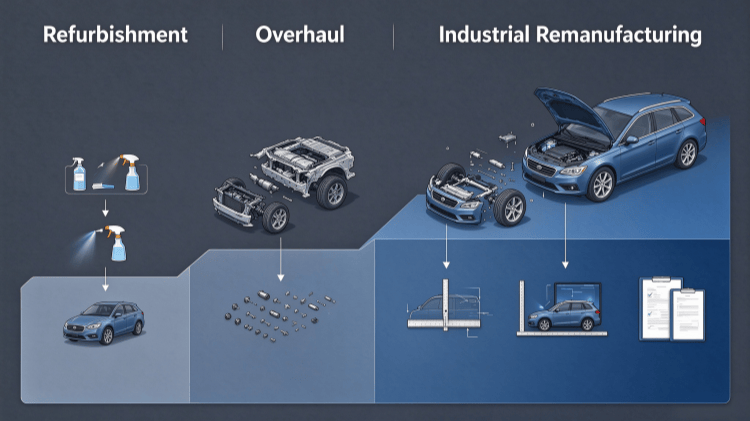
Refurbishment is the most basic form of equipment renewal. It focuses entirely on visual appearance and simple functional fixes. Core characteristics:
- Exterior cleaning, polishing, repainting, and tire replacement
- Only obvious broken parts are replaced
- No full disassembly, no internal wear detection
- No tolerance testing, no system calibration
Refurbished equipment looks new on the surface but retains all internal hidden defects, including metal fatigue, gear wear, seal aging, and electrical system drift. For high-intensity mining and construction scenarios, refurbished units have extremely high failure rates and unstable working performance.
Overhaul: Fault-Driven Partial Maintenance
Overhaul is a traditional mechanical maintenance method performed when equipment experiences obvious performance degradation or functional failure. Core characteristics:
- Disassembles only faulty assemblies instead of the whole vehicle
- Replaces broken parts to restore basic operability
- No unified OEM tolerance standards
- No systematic testing after repair
Overhaul is “problem-solving maintenance.” It does not predict or eliminate potential faults. After overhaul, equipment can work temporarily but will continue to degrade rapidly under heavy load. No consistent quality standard can be guaranteed.
True Remanufacturing: System-Level Performance Rebuild
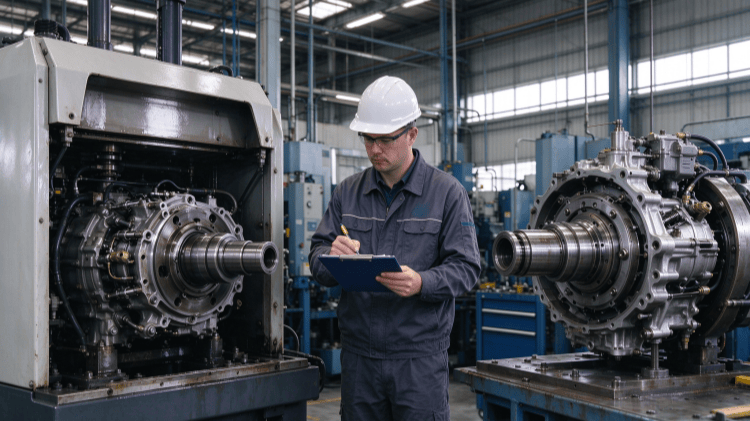
True remanufacturing is a complete industrial manufacturing process, not maintenance work. It rebuilds the entire asset from component level to system level. Core characteristics:
- 100% full disassembly and deep industrial cleaning
- Precision measurement of all components against OEM tolerances
- Regeneration or replacement of all worn and fatigued parts
- Standardized reassembly with unified torque specifications
- Multi-stage bench testing, load simulation, and system calibration
- Complete traceable quality archives and certification
True remanufacturing eliminates all hidden faults, restores factory-level performance, and delivers stable long-term operation. It is the only renovation method that can be used as formal fleet asset iteration.
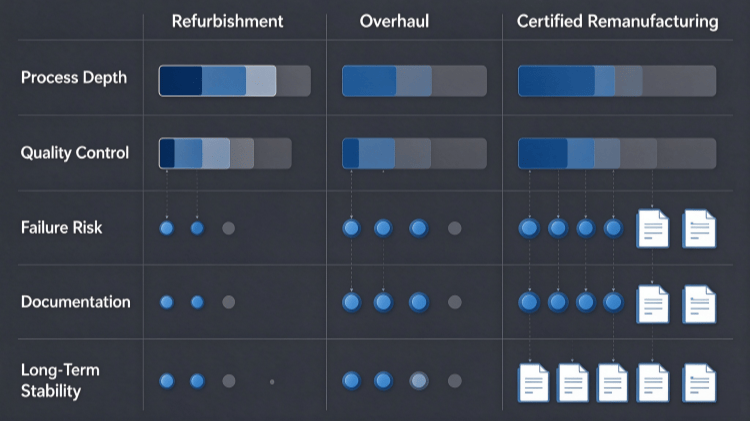
Key Industrial Comparison in One View
- Refurbishment: Appearance renewal only — High failure risk, short service life, no quality guarantee.
- Overhaul: Partial fault repair — Temporary usability, unstable performance, hidden residual wear.
- True Remanufacturing: Full system reconstruction — Near-new performance, low downtime, traceable quality, controllable TCO.
Why Professional Fleets Choose Reman Over Refurb & Overhaul
For modern project-based fleets, operational stability is more important than low purchase price. Refurbished and overhauled equipment cannot support continuous high-intensity shift work. Their frequent downtime, emergency repairs, and penalty losses far exceed the initial cost savings.
True remanufacturing provides verified, predictable, and stable asset performance, helping fleets control long-term operational costs and maximize project ROI.
Common Market Misconceptions
Many fleet buyers fall prey to misleading marketing labels. Vendors often use “rebuilt” or “remanufactured” loosely to sell simple refurbished trucks or basic overhauled units. Common misleading claims:
- “Fully rebuilt” only means repainting + changing damaged external parts
- “Engine reman” only fixes obvious engine leaks without full component inspection
- “Like-new condition” based purely on exterior appearance, with no component test records
Without standardized audit documents and component measurement reports, these descriptions carry no enforceable quality commitment. Buyers should always request traceable inspection logs before signing procurement contracts.
Compliance & Resale Value Impacts
The three asset types differ greatly in formal asset accounting, regulatory compliance and residual value.
- Refurbished units are recorded as used equipment; resale value drops sharply, and many project tender requirements exclude simple refurbished assets.
- Overhauled units are classified as maintained second-hand assets. Maintenance records are fragmented and hard to verify, limiting resale channels.
- Certified reman units have complete production and certification records. They can be formally booked as regenerated assets, with predictable depreciation curves and wider global resale markets. Certified reman vehicles are accepted in most international engineering tender projects.
Conclusion
Refurbishment improves appearance, overhaul fixes breakdowns, and true remanufacturing rebuilds performance. Understanding these core differences helps fleet operators avoid low-quality asset traps and select standardized, reliable reman solutions for large-scale fleet deployment.