
TCO Analysis: Standard Reman Vehicles vs Ordinary Used Heavy Equipment
Standard Reman Introduction
Total Cost of Ownership (TCO) is the most authoritative evaluation standard for professional fleet asset decision-making. Unlike simple purchase price comparison, TCO covers the full lifecycle expenses of heavy equipment, including procurement cost, daily operation, fuel consumption, maintenance repair, downtime loss, depreciation devaluation, and residual value recovery. For industrial fleets operating continuously for years, the hidden lifecycle costs often far exceed the initial purchase price.
Most grassroots procurement teams focus excessively on upfront cost differences, resulting in short-term low-cost purchases but long-term high-loss operations. This full TCO analysis systematically compares certified standard reman vehicles and ordinary used heavy equipment across all core dimensions, revealing why standard reman vehicles achieve far lower comprehensive lifecycle costs despite slightly higher entry prices.
Acquisition Cost: Surface Similarity, Essential Risk Gap
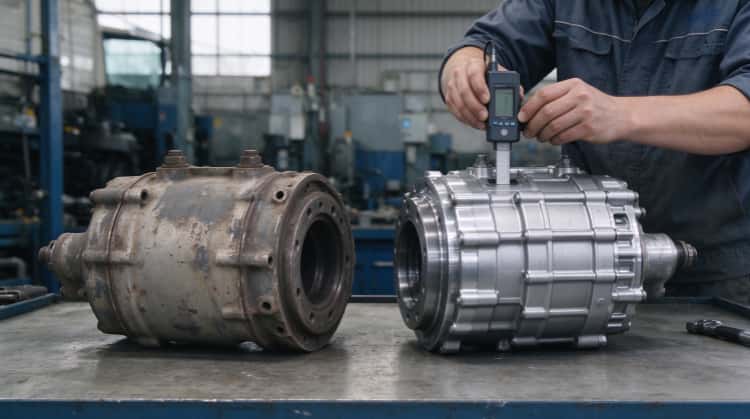
From a purely numerical perspective, ordinary second-hand heavy equipment has the lowest sticker price, while standard reman vehicles are slightly higher, and brand-new equipment is the most expensive. However, the low price of ordinary used equipment essentially prices in massive unknown risks.
Ordinary used trucks are traded in “as-is” condition. No systematic disassembly, no component measurement, no fatigue screening, and no standardized testing is performed. Historical overload usage, collision damage, improper maintenance, hidden structural deformation, and accumulated component wear are completely unrecorded and unprocessed. Buyers bear all future failure risks blindly.
Standard reman vehicles’ moderate premium is essentially a quality risk elimination cost. Every core component is disassembled, cleaned, measured against OEM tolerances, regenerated or replaced, and tested through multi-stage bench and load simulation. The higher procurement cost buys verified condition, controllable risks, and predictable performance — the fundamental difference between risky second-hand assets and standardized industrial assets.
Maintenance Cost Comparison: Reactive Chaos vs Predictable Stability
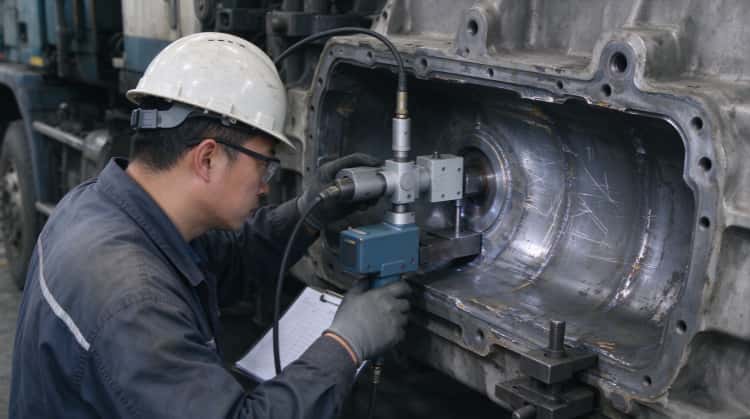
Ordinary used fleets feature completely reactive maintenance modes. Failures occur randomly under heavy load conditions, including sudden power drops, hydraulic system failures, sealing leakage, transmission abnormalities, and structural component failures. Each breakdown requires emergency troubleshooting, rushed part procurement, and overtime repair labor costs. The irregular failure pattern makes annual budget forecasting impossible.
Certified reman fleets adopt fully proactive maintenance logic. All aging components and fatigue structures are eliminated during the reman process. The vehicle exits the factory with standardized performance parameters and clear component health conditions. Fleet managers can formulate monthly, quarterly, and annual maintenance plans in advance.
Planned maintenance greatly reduces emergency repair expenses, avoids rush-order part markups, and extends component service life through scientific cycle inspection. Over three to five years of operation, the cumulative maintenance cost gap between reman fleets and ordinary used fleets becomes extremely significant.
Downtime Loss: The Largest TCO Hidden Expense
In industrial engineering scenarios, equipment downtime loss far exceeds direct repair costs. Once core haulage and construction equipment stops working, the entire site workflow chain stagnates, including material transportation, loading and unloading, construction coordination, and personnel scheduling. Long-term or frequent downtime directly delays project progress, triggers contract penalty clauses, and damages overall project profits.
Ordinary used equipment has extremely high unplanned downtime rates. Hidden wear accumulates and suddenly breaks down under continuous heavy load, causing unpredictable operational interruptions. Each failure creates cascading losses across the entire site team and construction schedule.
Standard reman vehicles eliminate latent faults through systematic industrial processes. Multi-stage factory testing simulates long-term heavy-load working conditions to verify system stability. Reman fleets only stop for scheduled maintenance, achieving extremely low unplanned downtime rates. For large-scale continuous operation projects, the stable uptime advantage creates massive invisible TCO savings year-round.
Fuel Efficiency & Operational Stability Differences
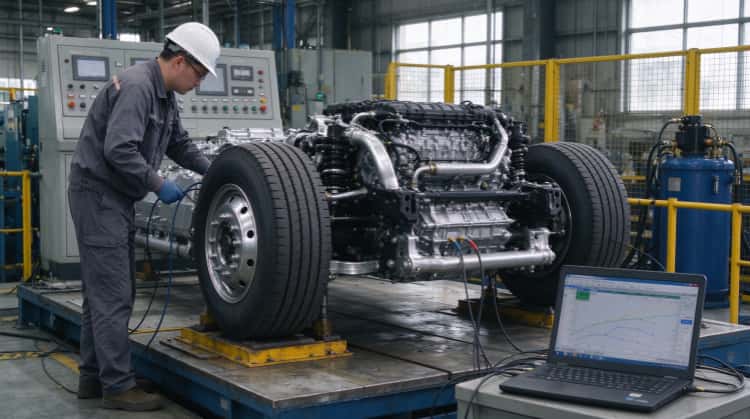
Long-term fleet operational costs are heavily affected by fuel consumption. Aged used equipment with worn piston assemblies, degraded sealing systems, loose transmission gaps, and uncalibrated hydraulic systems always operates in inefficient states. Excessive fuel consumption becomes a long-term hidden expense that is difficult for fleet managers to detect statistically.
Certified remanufacturing restores all key assemblies to OEM clearance standards. Engine combustion efficiency, hydraulic transmission efficiency, and mechanical matching precision return to near-new levels. Stable fuel consumption reduces daily operational costs and avoids energy waste caused by aging mechanical performance.
In high-intensity mining and earthmoving scenarios with thousands of annual operating hours, standardized fuel efficiency forms a continuous cost advantage, further compressing the TCO gap between reman assets and ordinary used assets.
Depreciation & Resale Value Differences Determine Final TCO
The final step of TCO calculation is asset residual value recovery. Ordinary used equipment depreciates rapidly in the secondary market due to unknown history, unverifiable quality, and frequent failure records. Buyers offer extremely conservative prices, resulting in huge capital losses for fleet owners during asset turnover.
Certified reman vehicles have complete traceable quality files. Inspection reports, component replacement logs, testing data, and certification records prove standardized rebuild quality. Secondary market buyers have full confidence in asset conditions, so certified reman vehicles maintain slower depreciation and higher residual value after long-term operation.
Higher residual value directly offsets procurement and operational costs, fundamentally lowering the full lifecycle total cost of ownership.
Conclusion
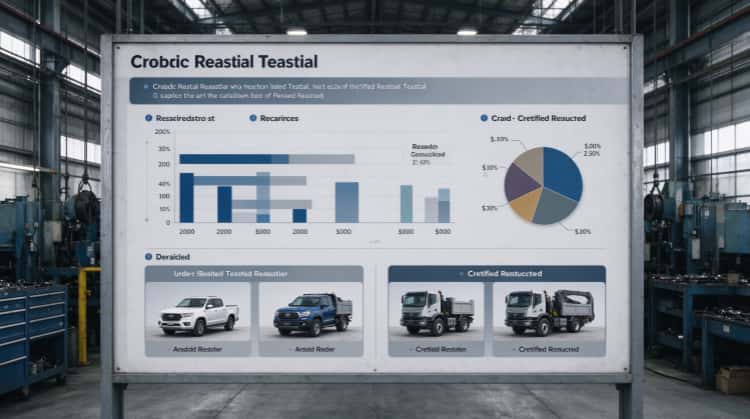
TCO analysis clearly proves that the lowest purchase price does not represent the lowest usage cost. Ordinary used equipment carries huge hidden risks in maintenance, downtime, fuel waste, and depreciation. Certified reman vehicles slightly increase upfront investment but achieve comprehensive cost reduction and risk control across the full lifecycle. For professional fleet asset management, certified remanufacturing is the optimal low-TCO solution for mid-and-long term industrial deployment.